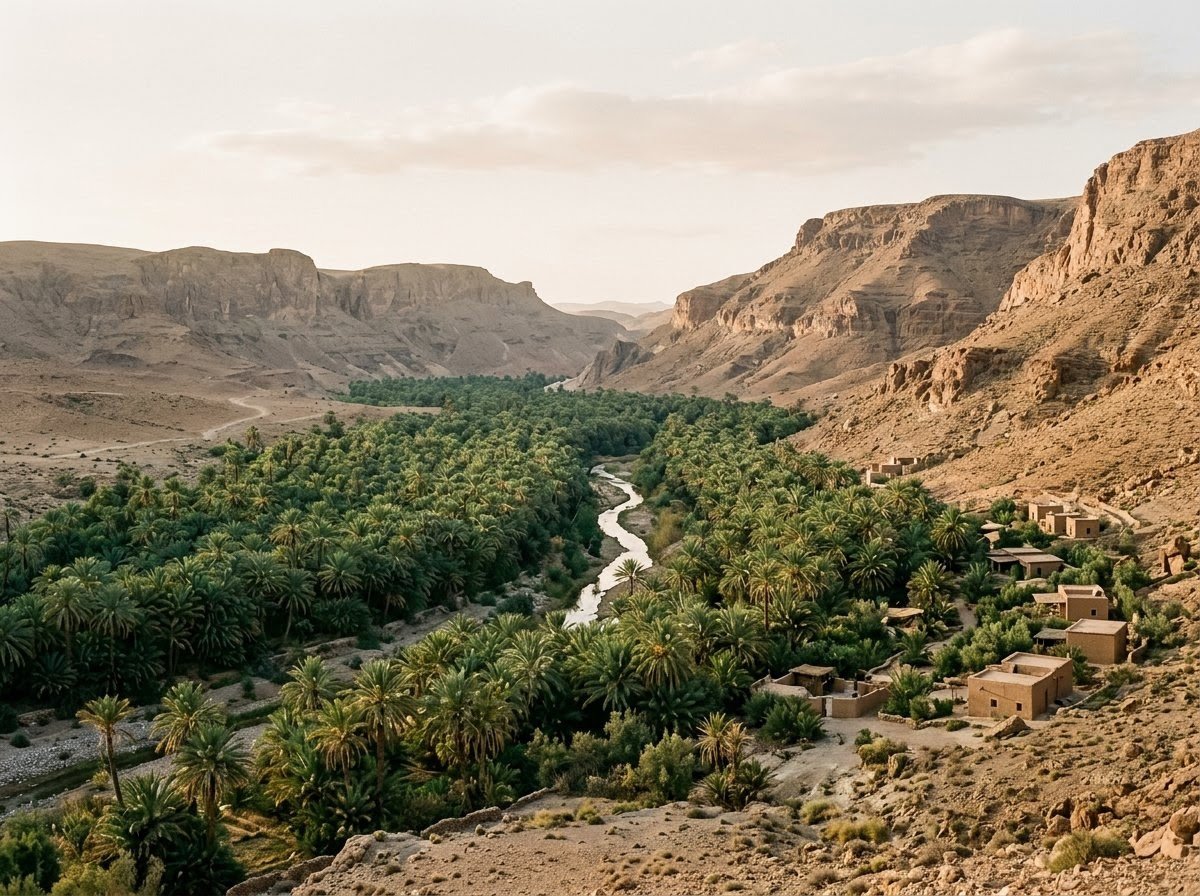
Drâa Valley, Morocco: Palm Groves, Kasbahs and the Gateway to the Sahara
The Drâa Valley is a living ribbon of green cut deep into the desert of southern Morocco: a line of date palms, mud-brick villages and slow water that has drawn travellers to Zagora for centuries. It is also the easiest, most beautiful way into the Sahara, and our camp sits right at its edge.
A river that gives life to the desert
Fed by snowmelt from the High Atlas, the Drâa is Morocco’s longest river, at about 1,100 kilometres. For most of its course it is a river of palm trees rather than water. The riverbed is often dry on the surface, but water keeps moving underground, which is why the gardens stay green and the wells stay full. In exceptional wet years the river has even reached the Atlantic.
Well over a million date palms crowd its banks in a valley barely wide enough to hold them. Between the groves sit fortified mud-brick villages, the ksour and kasbahs, built by the great caravan families who once shipped gold and salt across the Sahara. Underground irrigation channels called khettara have watered these oases for centuries.
The setting is full of contrast. Bare, rust-coloured mountains, including the Jbel Zagora above the town and the Bani range beyond, rise on either side of the green valley. Hard stone and living palms, silence and the rustle of leaves, all within easy reach of one another.
Where is the Drâa Valley?
The palm-grove corridor runs for roughly 200 kilometres, from Agdz in the north through Tamegroute and Zagora to M’hamid in the south, mostly along the N9 road. Agdz is about 70 km from Ouarzazate, and Zagora is around 360 km, or six to seven hours’ drive, from Marrakech. Most travellers split the trip over two days. For the route, stops and driving tips, read our Drâa Valley road trip guide.
What to see in the Drâa Valley
Agdz and Tamnougalt. Agdz is the first town where the valley opens into a green ribbon of palms. About 6 km away, Kasbah Tamnougalt is one of the oldest and best-preserved fortified villages in the valley, dating from the 16th century and once the seat of the Mezguita caids.
Tamegroute. A small village known for its green-glazed pottery and its centuries-old Quranic library of rare manuscripts, which welcomes visitors.
Zagora. The famous signpost reading “Timbuktu 52 days” by camel marks where caravans once left for the open desert. Climb the Jbel Zagora in under an hour for a view over the whole valley, stroll through the palm groves, and visit the Wednesday and Sunday souk, where farmers sell dates, spices and local pottery.
M’hamid El Ghizlane. The last village before the open Sahara, about 100 km south of Zagora and the starting point for the dunes of Erg Chigaga. Read more in our guide to M’hamid, gateway to the Sahara.
Things to do in the Drâa Valley
- Walk the palm groves at sunrise, when the light is soft and the air is cool.
- Taste fresh dates. The harvest peaks around October, when the valley smells sweet and the souks fill with fresh fruit.
- Ride a camel at sunset into the dunes. See our guide to camel trekking in Morocco.
- Explore the kasbahs and meet local craftspeople in Tamegroute.
- Stargaze. Away from city lights, the desert night sky is exceptionally clear.
- Go further into the Sahara with a 4×4 journey to Erg Chigaga.
More ideas in our list of things to do in Zagora.
Best time to visit the Drâa Valley
October to April is the best period. Days are warm and comfortable, and the palm groves are green. October also brings the date harvest, which adds a real layer of local life to your trip. If you visit at the end of October, you can combine it with the Taragalte Festival in M’hamid. Avoid June to August, when temperatures regularly reach 40 to 45°C. Desert nights can be close to freezing from December to February, so bring warm layers.
How far are the dunes?
This is worth knowing before you plan your days. The palm groves, villages and Tamegroute are close to Zagora, a short drive away. Smaller dunes are also within easy reach of Zagora. The great dunes of Erg Chigaga are further: about 100 km to M’hamid on tarmac (around 1.5 hours), then roughly 60 km on a desert track by 4×4 (around 2 hours). Plan it as an overnight trip with a night in the desert, not a quick detour. We can arrange it for you.
Why we chose the Drâa
Taragalte sits at the edge of this valley, close enough to the groves and the villages to feel their rhythm, and open enough to the desert for real silence. Mornings begin with the sound of the river canal and the first call of birds in the palms. Evenings end with the last warmth of the sun on the dune. It is the gentlest possible door into the Sahara, and, we think, the most beautiful one.
Stay with us in the Drâa Valley
Our camp in Tahtah, near Zagora, offers comfortable rooms with air conditioning, adobe bungalows and camping pitches, a Moroccan restaurant with produce from our organic garden, and camel treks straight into the dunes. See our rooms and camp or read our guide to where to stay in the Zagora desert.
Book in 3 steps:
- Message us on WhatsApp at +212 678 963 735.
- Tell us your dates and number of guests.
- We confirm availability and help you plan your days.
Frequently asked questions
Where is the Drâa Valley? In southern Morocco, running about 200 km from Agdz through Zagora to M’hamid along Morocco’s longest river.
How long should I spend in the Drâa Valley? Two days is the minimum from Marrakech. Three or more lets you explore at a slower pace, including a night in the desert.
When is the best time to visit? October to April. October also brings the date harvest.
Is the Drâa Valley worth visiting? Yes. It combines palm groves, ancient kasbahs and easy access to the Sahara, with far fewer crowds than the more famous routes.
How far is Zagora from the Sahara dunes? Smaller dunes are close to Zagora. The great dunes of Erg Chigaga are about 100 km to M’hamid plus 60 km by 4×4 track.
Can you arrange tours from your camp? Yes. We can arrange camel treks, 4×4 excursions and overnight desert trips.
Ready to explore the Drâa Valley? Message us on WhatsApp and we will help you plan it.
Leave a Reply